Numerical Simulation of 2D Axisymmetric Flow Within Pressure swirl atomizer using InterFoam
DOI:
https://doi.org/10.63318/waujpasv4i1_03Keywords:
Pressure swirl atomizer, 2D axisymmetric simplex atomizer, InterFoam, Volume of fluidAbstract
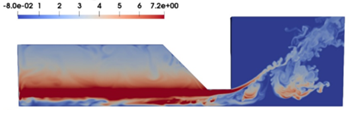
This study evaluates the open-source CFD solver InterFoam for simulating multiphase flow in a 2D axisymmetric pressure-swirl atomizer using water and air. Motivated by the computational and experimental constraints of 3D studies, the research investigates two atomizer dimensions under a laminar flow assumption. The Volume of Fluid (VOF) method and Continuum Surface Force (CSF) model are employed for interface tracking and surface tension. Qualitatively, the solver accurately captures key flow features, including air-core formation, swirling sheet emanation, and characteristic low-pressure distributions. Quantitatively, interFoam shows excellent agreement with experimental data for Case 1, with average swirling velocity errors of 6.11% at the inlet and 7.18% at the exit. However, Case 2 resulted in significant errors (49.05% and 14.43%) because the laminar assumption is invalid at the high Reynolds number (Re 74,246) present. This highlights the necessity of turbulence modeling for high-Re pressure-swirl flows. Finally, the solver’s performance in predicting the flow number, discharge coefficient, and spray cone angle outperformed literature findings based on inviscid analysis and maximum flow theory. The results suggest that accurate representation of swirling velocity profiles, alongside the swirl number, serves as a critical indicator for when turbulence models must be adopted.
Downloads
Downloads
Published
Issue
Section
License
Copyright (c) 2025 Abdallah Salem, Abulhafiz Aqila, Mohammed Hamdan

This work is licensed under a Creative Commons Attribution-NonCommercial 4.0 International License.
This journal uses Creative Commons Attribution-Noncommerical 4.0 International License (CC BY-NC 4.0), which permits use, sharing, adaptation, distribution and reproduction in any medium or format, as long as you give appropriate credit to the original author(s) and the source, provide a link to the Creative Commons license, and indicate if changes were made. To view a copy of this license, visit https://creativecommons.org/licenses/by-nc/4.0/.
Copyright of articles
Authors retain copyright of their articles published in this journal.