Wavelet-Enhanced DEMON Processing and Deep Learning for Passive SONAR Target Recognition
DOI:
https://doi.org/10.63318/waujpasv4i2_26Keywords:
Passive sonar, Discrete wavelet transform, DEMON, Convolutional neural networks, Underwater acousticsAbstract
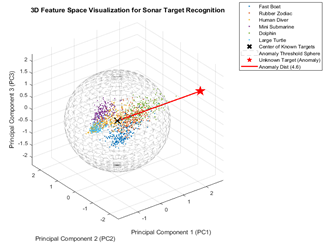
This paper presents an integrated underwater Automatic Target Recognition (ATR) framework that synergizes advanced signal processing with deep learning. To eliminate non-stationary ambient ocean noise and isolate low-frequency modulations, the raw acoustic pressure signals undergo pre-denoising via Discrete Wavelet Transform (DWT with db4 mother wavelet and soft-thresholding), followed by Detection of Envelope Modulation on Noise (DEMON) analysis to yield 128-bin spectral feature vectors. Classification is performed using a dedicated 7-layer 1D Convolutional Neural Network (1D-CNN) architecture terminating in a Softmax output layer. Acoustic simulations in MATLAB R2024b generated a balanced dataset of 1,200 audio samples (200 samples per class across six distinct targets: fast boat, rubber zodiac, human diver, giant turtle, dolphin, and mini submarine) propagated through a 20–40 path shallow-water multipath channel ( ). Experimental evaluations demonstrate an overall classification accuracy of 94.93% and a macro-averaged F1-score of 0.9505. Coupled with an average inference latency of 11.40 ms per target and Euclidean distance-based thresholding for out-of-distribution anomaly detection, the proposed system proves computationally efficient and well-suited for real-time passive underwater surveillance.
Downloads
Downloads
Published
Issue
Section
License
Copyright (c) 2026 The authors

This work is licensed under a Creative Commons Attribution-NonCommercial 4.0 International License.
This journal uses Creative Commons Attribution-Noncommerical 4.0 International License (CC BY-NC 4.0), which permits use, sharing, adaptation, distribution and reproduction in any medium or format, as long as you give appropriate credit to the original author(s) and the source, provide a link to the Creative Commons license, and indicate if changes were made. To view a copy of this license, visit https://creativecommons.org/licenses/by-nc/4.0/.
Copyright of articles
Authors retain copyright of their articles published in this journal.