Design and Implementation of a Remotely Monitored Hybrid Renewable Energy System with IoT-Based Relay Control and Real-Time Data Logging
DOI:
https://doi.org/10.63318/waujpasv4i2_28Keywords:
Solar PV, Wind energy, Arduino Mega 2560, PWM charge controller, MQTT protocol, IoT, Sensors, SD cardAbstract
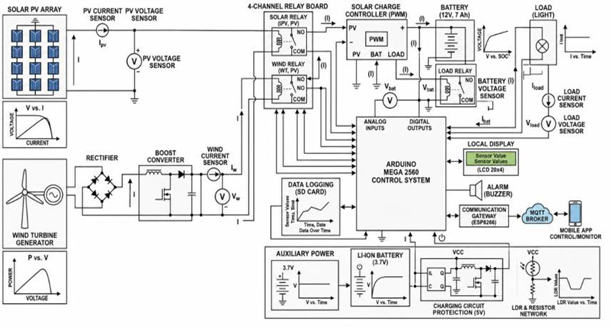
This paper presents a cost-effective smart hybrid renewable energy system (HRES) that integrates solar PV and wind energy systems and supports VRLA battery systems and DC loads. Stand-alone renewable energy systems are subject to intermittence. The design proposed in this paper addresses this issue by integrating both renewable energy systems using a four-channel relay board with an embedded electrical interlock that prevents simultaneous dual-source injection to a PWM charge controller and maintains solar energy priority. The control unit was an Arduino Mega 2560. It read the voltage and current of the PV, wind, and battery systems through the ACS712 Hall effect sensors and B25 voltage dividers, and established a solar-priority interlock. The interlock was improved by remote relay control through the MQTT protocol. The system logged data every 10 seconds in CSV format, displayed information on a 20 × 4 I²C LCD, and sent data wirelessly with the ESP8266 module to a MIT App Inventor mobile application via MQTT. Two test sessions were conducted. Session B (January 16, 2026) was an early validation test. Session C (March 13, 2026) was the main test and was conducted after the sensors were replaced and recalibrated. The combined-source load test (2.83 minutes) was conducted with a mean load power of 25.70 W and a single-sample peak of 26.79 ± 1.5 W (99.2 ± 5.6 % of the rated load). The maximum solar and wind powers were 34.36 W and 10.05 W, respectively. Following the implementation of necessary corrective measures, the relay and measurement consistency for both wind and output was 100%, confirming that the interlock and control logic performed as designed.
Downloads
Downloads
Published
Issue
Section
License
Copyright (c) 2026 Authors

This work is licensed under a Creative Commons Attribution-NonCommercial 4.0 International License.
This journal uses Creative Commons Attribution-Noncommerical 4.0 International License (CC BY-NC 4.0), which permits use, sharing, adaptation, distribution and reproduction in any medium or format, as long as you give appropriate credit to the original author(s) and the source, provide a link to the Creative Commons license, and indicate if changes were made. To view a copy of this license, visit https://creativecommons.org/licenses/by-nc/4.0/.
Copyright of articles
Authors retain copyright of their articles published in this journal.