Comparative Performance of PSO-MPPT and Conventional P&O-MPPT Algorithms for Photovoltaic Systems
DOI:
https://doi.org/10.63318/waujpasv4i2_51Keywords:
Photovoltaic (PV) System, Maximum Power Point (MPP), Maximum Power Point Tracking (MPPT), Particle Swarm Optimization (PSO), Perturb and Observe (P&O), DC–DC Boost ConverterAbstract
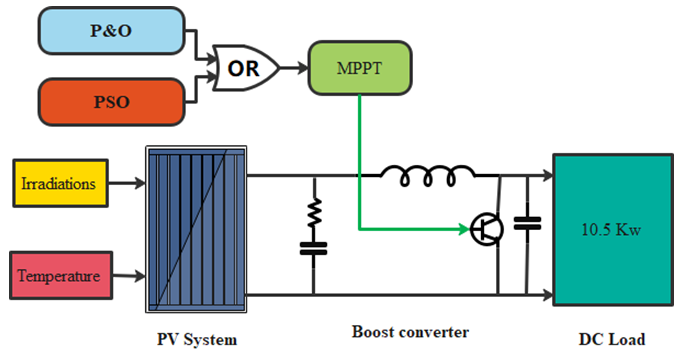
Maximum power point tracking (MPPT) is used to maximize the extraction of the power available from photovoltaic (PV) arrays as irradiance and temperature change. This study compares conventional Perturb and Observe (P&O) and Particle Swarm Optimization (PSO) MPPT algorithms applied independently to the same PV-array/boost-converter system supplying a DC load rated at approximately 10.5 kW. The array comprises 64 monocrystalline PV modules and has an installed nominal capacity of approximately 21.1 kW based on the module rating reported in Table 1. The nominal array capacity, load rating, and instantaneous operating power are distinct quantities; the simulated waveforms show extracted PV power reaching approximately 15–16 kW under the modelled operating conditions. Voltage, current, power, transient response, and steady-state oscillatory behaviour are compared. Both algorithms move the PV operating point toward the maximum-power region. The observed PSO response recovers after the imposed operating transitions, but it also exhibits appreciable current and power oscillations. Accordingly, the results support a balanced comparison between dynamic recovery and steady-state ripple rather than an unconditional claim of superiority for either method.
Downloads
Downloads
Published
Issue
Section
License
Copyright (c) 2026 The author

This work is licensed under a Creative Commons Attribution-NonCommercial 4.0 International License.
This journal uses Creative Commons Attribution-Noncommerical 4.0 International License (CC BY-NC 4.0), which permits use, sharing, adaptation, distribution and reproduction in any medium or format, as long as you give appropriate credit to the original author(s) and the source, provide a link to the Creative Commons license, and indicate if changes were made. To view a copy of this license, visit https://creativecommons.org/licenses/by-nc/4.0/.
Copyright of articles
Authors retain copyright of their articles published in this journal.