An Exploratory Study of the Potential Antibiotic-Enhancing Effect of Bee Venom Against Uropathogens in Patients with Type 2 Diabetes Mellitus at Brack General Hospital, Libya
DOI:
https://doi.org/10.63318/waujpasv4i2_52Keywords:
Bee venom, Uropathogens, Urinary tract infection, Type 2 diabetes mellitus, Antimicrobial resistance, Antibiotic susceptibilityAbstract
Antimicrobial resistance is a growing global health concern, necessitating alternative strategies to improve antibiotic efficacy. This study aimed to conduct an in vitro exploratory assessment of the potential antibiotic-enhancing effect of bee venom against uropathogens isolated from patients with type 2 diabetes mellitus at Brack Al-Shati General Hospital, Libya. The study focused on observing preliminary changes in antibiotic susceptibility in the presence of bee venom rather than quantitatively evaluating antibiotic synergy.
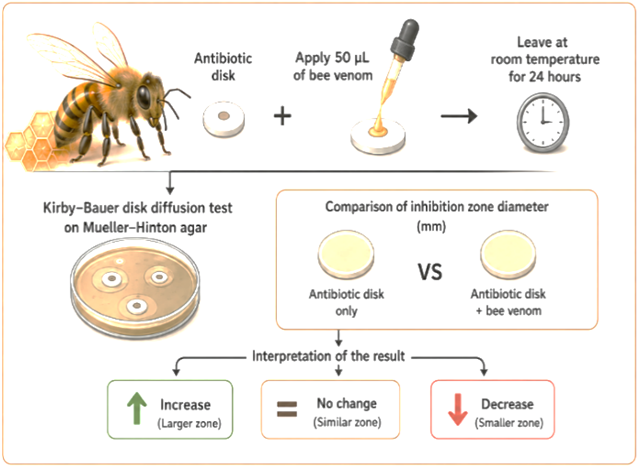
Materials and Methods: This laboratory-based exploratory study included 51 patients with T2DM (29 males and 22 females), aged ≥40 years, recruited from July 20 to October 1, 2023. Urine samples underwent urinalysis and bacterial culture, followed by isolate identification using conventional methods and the API 20E system. Although 51 patients were enrolled, only nine bacterial isolates were recovered and included in the antimicrobial experiments. Antibiotic susceptibility was assessed using the Kirby–Bauer disk diffusion method, and results were interpreted according to the Clinical and Laboratory Standards Institute (CLSI) M100-S27, 27th edition (2017), using species- and antibiotic-specific interpretive criteria. A volume of 50 µL of undiluted bee venom preparation was applied to each antibiotic disk, and changes in inhibition-zone diameters were assessed descriptively. The Wilcoxon signed-rank test was used for paired comparisons, with emphasis on effect sizes given the small number of isolates. Quantitative synergy assays were not performed.
Results: Nine bacterial isolates were recovered, comprising five Gram-negative and four Gram-positive isolates. Escherichia coli was the predominant Gram-negative isolate, whereas Staphylococcus epidermidis was the predominant Gram-positive isolate. Overall comparison of inhibition-zone diameters before and after bee venom addition showed no statistically significant change. Among Gram-negative bacteria, the median inhibition-zone diameter decreased from 30.0 mm to 26.0 mm (P = 0.276), with a moderate effect size (r = 0.445), whereas the median diameter among Gram-positive bacteria remained unchanged at 16.5 mm (P = 0.498), with a moderate effect size (r = 0.303). Nevertheless, some antibiotic combinations showed an apparent enhancement of antibacterial activity, particularly when bee venom was combined with cefotaxime and gentamicin against selected Gram-negative isolates, and with levofloxacin, cefotaxime, and vancomycin against selected Gram-positive isolates.
Conclusion: Bee venom may have a potential antibiotic-enhancing effect against selected bacterial strains; however, these preliminary observations require confirmation through larger studies using quantitative antimicrobial assays, such as MIC and MBC, together with specialized synergy testing to determine the nature of the interaction between bee venom and antibiotics.
Downloads
Downloads
Published
Issue
Section
License
Copyright (c) 2026 The authors

This work is licensed under a Creative Commons Attribution-NonCommercial 4.0 International License.
This journal uses Creative Commons Attribution-Noncommerical 4.0 International License (CC BY-NC 4.0), which permits use, sharing, adaptation, distribution and reproduction in any medium or format, as long as you give appropriate credit to the original author(s) and the source, provide a link to the Creative Commons license, and indicate if changes were made. To view a copy of this license, visit https://creativecommons.org/licenses/by-nc/4.0/.
Copyright of articles
Authors retain copyright of their articles published in this journal.