A Coupled Viscous-Turbulent Nonlinear Schrödinger-Ginzburg-Landau Model for Analyzing Wave-Turbulence Interaction and Energy Dissipation in Coastal Engineering Systems
DOI:
https://doi.org/10.63318/Keywords:
Nonlinear Schrödinger equation, Complex Ginzburg-Landau equation, Wave turbulence interaction, Coastal engineering, Energy dissipation, Multi-scale asymptotic analysisAbstract
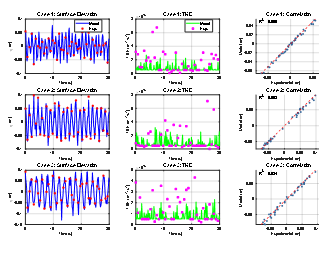
Coastal engineering systems really struggle to accurately predict how waves and turbulence interact and how energy gets dissipated, especially during extreme weather conditions and when the seabed shape is complicated. This paper presents a novel coupled viscous-turbulent nonlinear Schrödinger-Ginzburg-Landau (NLS-GL) model integrating dispersive wave dynamics with turbulent energy cascade processes. We derive the coupled system through rigorous asymptotic analysis and multi-scale perturbation methods, obtaining explicit expressions for all coupling coefficients. Important clarifications on model scope and limitations: The model is derived under the assumption of weak nonlinearity ( ), where is the wave amplitude and is water depth. The implementation is primarily one-dimensional ( -direction), though we discuss extension to two dimensions for fair comparison with Reynolds-averaged Navier-Stokes (RANS) approaches. The turbulence model assumes homogeneous turbulent statistics in the transverse direction, neglecting vertical stratification effects. These assumptions restrict applicability to coastal regions where: (i) waves are not strongly breaking, (ii) turbulence is primarily horizontally uniform, and (iii) envelope variations occur slowly compared to the carrier wave period. Despite these constraints, the model demonstrates strong agreement with experimental data for energy dissipation predictions (errors below for validated cases), while providing approximately computational efficiency gains over traditional RANS approaches. We further present a 2D extension demonstrating applicability to harbor resonance and breakwater optimization. The framework is particularly valuable for preliminary design iterations where the assumptions are reasonable.
Downloads
Downloads
Published
Issue
Section
License
Copyright (c) 2026 The authors

This work is licensed under a Creative Commons Attribution-NonCommercial 4.0 International License.
This journal uses Creative Commons Attribution-Noncommerical 4.0 International License (CC BY-NC 4.0), which permits use, sharing, adaptation, distribution and reproduction in any medium or format, as long as you give appropriate credit to the original author(s) and the source, provide a link to the Creative Commons license, and indicate if changes were made. To view a copy of this license, visit https://creativecommons.org/licenses/by-nc/4.0/.
Copyright of articles
Authors retain copyright of their articles published in this journal.