Cereal Straw in Al-Jabal Al-Akhdar, Libya: Gross-Residue Screening and a Conditional CHP Energy Balance
DOI:
https://doi.org/10.63318/waujpasv4i2_63Keywords:
Cereal straw, Crop residues, Gross residue generation, Combined heat and power, Organic Rankine cycle, Biomass supplyAbstract
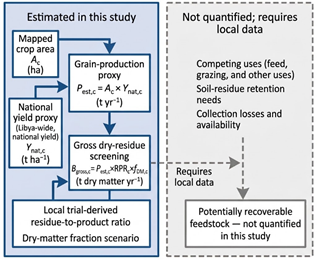
Cereal straw is often presented as a potential energy feedstock before its availability has been established. This study links a gross-residue screen for wheat and barley in Al-Jabal Al-Akhdar, Libya, to a conditional engineering test for biomass combined heat and power (CHP). Mapped areas for 2022-2023, Libya-wide grain-yield proxies for 2022, and published local straw-to-grain observations were combined with stated dry-matter scenarios. The central estimate is 69.35 kt yr-1 of gross dry wheat straw and 2.85 kt yr-1 of barley straw, or 72.20 kt yr-1 combined; the deterministic low and high cases are 44.51 and 97.75 kt yr-1. A separate, explicitly hypothetical boiler-organic Rankine cycle CHP balance uses an effective straw-delivery fraction of 20%, a dry-basis lower heating value of 15 MJ kg-1, 12% net electric efficiency and 60% recoverable thermal efficiency. On the central gross-residue case, these assumptions yield 7.22 GWh yr-1 of net electricity and 18.05 GWh yr-1 of utilized heat if half the recoverable heat is used. A 1 MW net electric target operated for 6,000 full-load hours would require 16.6% of gross dry straw to reach the plant under the same assumptions. Neither the delivery fraction nor fuel and plant performance have been measured locally; the CHP figures are conditional design tests, not forecasts or evidence of project feasibility. The calculation identifies which farm-supply, fuel-quality and heat-demand measurements must precede an engineering feasibility study.
Downloads
Downloads
Published
Issue
Section
License
Copyright (c) 2026 Authors

This work is licensed under a Creative Commons Attribution-NonCommercial 4.0 International License.
This journal uses Creative Commons Attribution-Noncommerical 4.0 International License (CC BY-NC 4.0), which permits use, sharing, adaptation, distribution and reproduction in any medium or format, as long as you give appropriate credit to the original author(s) and the source, provide a link to the Creative Commons license, and indicate if changes were made. To view a copy of this license, visit https://creativecommons.org/licenses/by-nc/4.0/.
Copyright of articles
Authors retain copyright of their articles published in this journal.