Optimization Study of Converting the Derna Steam Power Plant to a Combined Gas/Steam Cycle
DOI:
https://doi.org/10.63318/waujpasv4i2_07Keywords:
Combined Gas/Steam Cycle, Steam Power Plant, Efficiency, Derna, LibyaAbstract
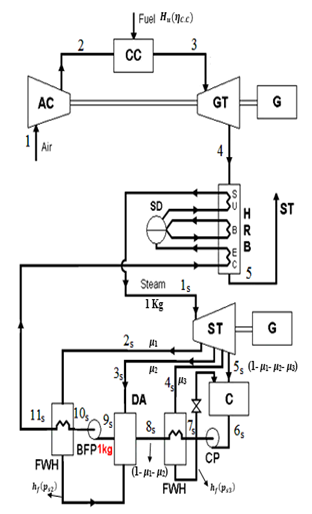
Research efforts have switched to increasing the efficiency of systems that convert thermal energy into mechanical labor due to the rise in the cost of oil and fuel gas over the past 20 years and the risks of environmental contamination.. Combined gas/steam power plants (CGSPP) are becoming more widespread due to their excellent thermal efficiency, higher capacity, and low environmental impact. The current research focuses on the theoretical analysis of CGSPP, which uses a single-pressure heat recovery boiler without supplemental fire. A computer program for the studied combined cycle based on the burning of 1 kmoles of natural gas in the combustor of the gas turbine is built utilizing the conservation equations for mass and energy, as well as combustion calculations. Each component of the combined cycle is assigned a unique subprogram using Engineering Equation Solver (EES). The results reveal that the combined cycle's maximum efficiency may be obtained at around 47.24 ⸓ as long as the boiler pressure remains constant. Since improved combined-cycle efficiency is the goal, modest compressor pressure ratios must be used. At a high compressor pressure ratio, the boiler pressure must be reduced to maintain a positive temperature differential at the pinch point. To minimize a loss in combined cycle efficiency at high compressor pressure ratios, we propose using a dual-pressure boiler.
Downloads
Downloads
Published
Issue
Section
License
Copyright (c) 2026 Authors

This work is licensed under a Creative Commons Attribution-NonCommercial 4.0 International License.
This journal uses Creative Commons Attribution-Noncommerical 4.0 International License (CC BY-NC 4.0), which permits use, sharing, adaptation, distribution and reproduction in any medium or format, as long as you give appropriate credit to the original author(s) and the source, provide a link to the Creative Commons license, and indicate if changes were made. To view a copy of this license, visit https://creativecommons.org/licenses/by-nc/4.0/.
Copyright of articles
Authors retain copyright of their articles published in this journal.