Simulation-Based Multi-Stage Radar Framework for Human Detection, Tracking, Fall Recognition, and Post-Fall Vital-Sign Estimation
DOI:
https://doi.org/10.63318/waujpasv4i2_55Keywords:
Radar fusion, Human detection, Kalman tracking, Target tracking, Fall detection, Vital-sign estimationAbstract
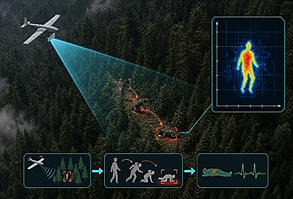
This paper attempts to maintain target identity, detect falls, and evaluate the physiological state after falling in the SAR environment using radar.it also introduces a multi-stage radar sensor fusion framework that leverages confidence-based fusion, Kalman tracking, kinematic fall detection, and gated physiological estimation and that is implemented in MATLAB. The proposed method achieves asimulated results with a 98% probability of detection, fall F1 of 0.96, and physiological estimation errors of 0.89 cycles/minute (breathing) and 1.2 beats/minute (heartbeats) while achieving a reduction of 75.9% (gating) and 82.4% (fall triggering) processing unnecessarily. Simulation-based evaluation only; performance deteriorates in cases of dense clutter, multipath, and domain shifts, where track loss during occlusion and fall misclassification due to fast motion remain open problems.
Downloads
Downloads
Published
Issue
Section
License
Copyright (c) 2026 The authors

This work is licensed under a Creative Commons Attribution-NonCommercial 4.0 International License.
This journal uses Creative Commons Attribution-Noncommerical 4.0 International License (CC BY-NC 4.0), which permits use, sharing, adaptation, distribution and reproduction in any medium or format, as long as you give appropriate credit to the original author(s) and the source, provide a link to the Creative Commons license, and indicate if changes were made. To view a copy of this license, visit https://creativecommons.org/licenses/by-nc/4.0/.
Copyright of articles
Authors retain copyright of their articles published in this journal.