Modelling and Stability Analysis of (TIV) System Using Lyapunov Function
DOI:
https://doi.org/10.63318/waujpasv4i1_22Keywords:
Lyapunov function, Linearization, Stability analysis, Cancer model, OncolyticAbstract
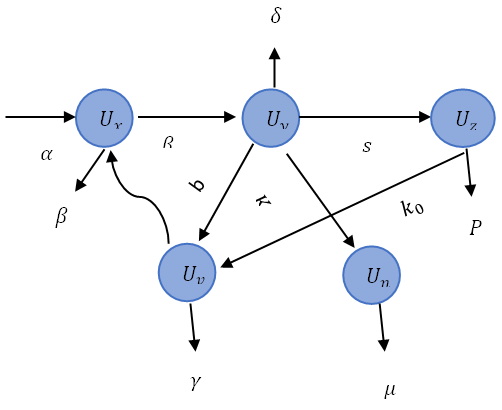
Tumour Immune Virus (TIV) model is theoretically analysed based on a system of five nonlinear ordinary differential equations (NODEs). The model is divided into five compartmental classes: uninfected cancer cells , virus-infected cancer cells immune effector cells dead cells and free virus particles . The aim is to investigate the stability of the deterministic TIV model both analytically and numerically, utilising the Lyapunov function and the Runge-Kutta-Fehlberg (RKF) method. For the deterministic model, five steady points are derived, and their local and global stability are investigated for the coexistence steady point; however, specific criteria were employed to confirm the existence and stability of these steady states. Also, numerical simulations were conducted to study the dynamic behaviour of the TIV system, whose findings offer more insights into the impact of oncolytic treatment on the immune response and contribute to the development of more effective strategies.
Downloads
Published
Issue
Section
License
Copyright (c) 2026 The author

This work is licensed under a Creative Commons Attribution-NonCommercial 4.0 International License.
This journal uses Creative Commons Attribution-Noncommerical 4.0 International License (CC BY-NC 4.0), which permits use, sharing, adaptation, distribution and reproduction in any medium or format, as long as you give appropriate credit to the original author(s) and the source, provide a link to the Creative Commons license, and indicate if changes were made. To view a copy of this license, visit https://creativecommons.org/licenses/by-nc/4.0/.
Copyright of articles
Authors retain copyright of their articles published in this journal.