Designing A Protective Case to Reduce Electromagnetic Radiation Emitted from Mobile Phones Using CST Software
DOI:
https://doi.org/10.63318/waujpasv4i1_36Keywords:
Electromagetic radiation, Mobile phone emissions, Shielding effectiveness, Specific absorption rate (SAR)Abstract
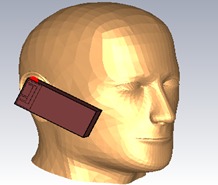
In this paper, a Planar Inverted-F Antenna (PIFA) is designed for mobile applications. And to study the effect of incorporating a synthetic material shell that consists of 12 split ring resonator (SRR) cells, each cell containing two overlapping rings to improve safety from electromagnetic radiation. The free-space antenna performance was analyzed before and after shell integration, based on the key performance indicators reflection coefficient (S11), return wave ratio (VSWR), radiation efficiency, radiation pattern, placement of the phone next to a human head model to study electric field distribution and surface currents, and specific absorption rate (SAR) values. Simulation results showed that incorporating the enclosure did not negatively affect the antenna matching or radiation characteristics. The value of S11 remained below -10dB at the fundamental frequencies, at an operating frequency of 0.89GHz and a power supply of 0.5w. The value of SAR-1g decreased from 3.05 kg/w to 2.91 kg/w, a decrease of 4.6%. The value of SAR-10g decreased from 2.39 kg/w to 2.25 kg/w (a decrease of 5.9%). The results confirm that the incorporation of the 12-cell SRR material shell achieves an effective balance between reducing the specific absorption rate and maintaining antenna performance, making it a practical solution for improving electromagnetic safety in mobile phones.
Downloads
Downloads
Published
Issue
Section
License
Copyright (c) 2026 The authors

This work is licensed under a Creative Commons Attribution-NonCommercial 4.0 International License.
This journal uses Creative Commons Attribution-Noncommerical 4.0 International License (CC BY-NC 4.0), which permits use, sharing, adaptation, distribution and reproduction in any medium or format, as long as you give appropriate credit to the original author(s) and the source, provide a link to the Creative Commons license, and indicate if changes were made. To view a copy of this license, visit https://creativecommons.org/licenses/by-nc/4.0/.
Copyright of articles
Authors retain copyright of their articles published in this journal.