Comparison of Water Sorption and Solubility of CAD/CAM Milled PMMA, 3D-Printed PMMA, and 3D-Printed Resin Dental Polymers
DOI:
https://doi.org/10.63318/waujpasv4i2_11Keywords:
Water sorption, Water solubility, CAD/CAM PMMA, 3D-printed PMMA, 3D-printed resin, Dental polymers, Hydrolytic stabilityAbstract
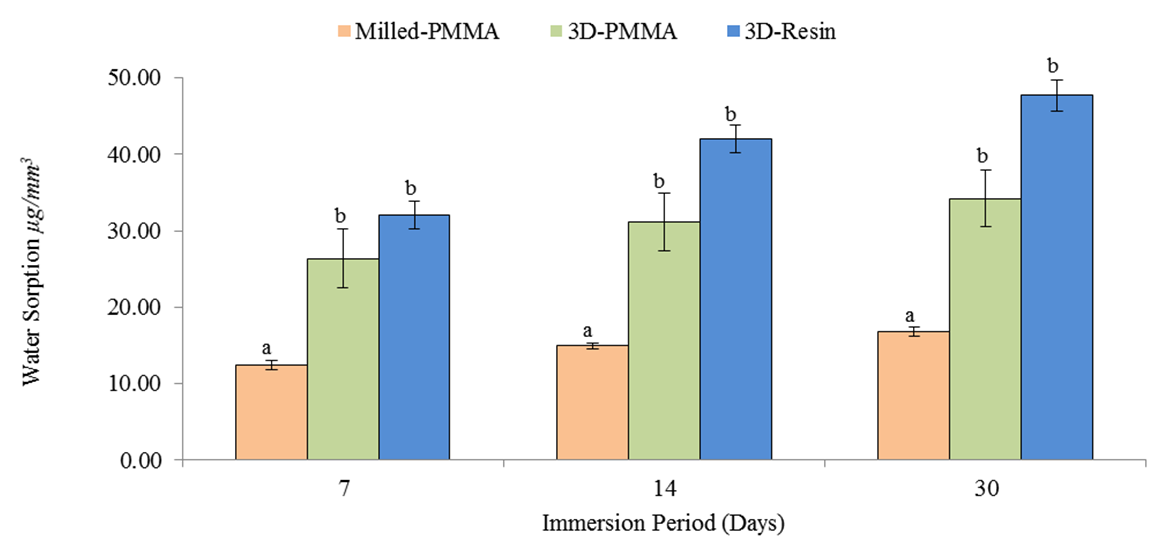
The objective of this study was to evaluate and compare the water sorption and solubility of three dental restorative polymers—CAD/CAM milled PMMA, 3D-printed PMMA, and 3D-printed resin—after aging for different time intervals. For this purpose, thirty specimens (n = 10/group) were fabricated from CAD/CAM milled PMMA (PMMA DISC), 3D-printed PMMA (Temporary Crown), and 3D-printed resin (SDC Resin). Specimens were dried in a ventilated oven at 45 °C for 24 hours, and then immersed in purified water at 23 ±1°C. The masses were measured after 7, 14, and 30 days. Water sorption (Wsp) and solubility (Wsl) were calculated in µg/mm³. Assumptions of normality, variance homogeneity, and sphericity were tested. Sorption was analyzed via two-way repeated measures ANOVA with Games-Howell post-hoc; solubility, which violated normality, via Kruskal-Wallis with Dunn's post-hoc (α = 0.05). The achieved results showed that water sorption increased significantly with immersion time in all materials (p < 0.001). 3D-Resin demonstrated the highest sorption values, followed by 3D-PMMA, while Milled-PMMA exhibited the lowest values at all time intervals. At 30 days, mean sorption values were 16.77 ± 0.58 µg/mm³ (Milled-PMMA), 34.18 ± 3.68 µg/mm³ (3D-PMMA), and 47.68 ± 2.07 µg/mm³ (3D-Resin). Water solubility differed significantly among the tested materials (p < 0.001), with 3D-PMMA showing the highest solubility (5.39 ± 4.10 µg/mm³), followed by 3D-Resin (3.12 ± 1.63 µg/mm³), while Milled-PMMA exhibited negative values (−0.40 ± 0.26 µg/mm³). Consequently, it was concluded that material composition and immersion duration have a significant influence on water sorption and solubility of dental polymers. CAD/CAM milled PMMA exhibited higher hydrolytic stability, whereas 3D-printed resins demonstrated higher sorption and solubility, which makes them more susceptible to hydrolytic degradation. Clinically the materials selection for digitally fabricated restorations is critical, as the increased water sorption and solubility in 3D-printed resins may affect long-term clinical performance.
Downloads
Downloads
Published
Issue
Section
License
Copyright (c) 2026 The authors

This work is licensed under a Creative Commons Attribution-NonCommercial 4.0 International License.
This journal uses Creative Commons Attribution-Noncommerical 4.0 International License (CC BY-NC 4.0), which permits use, sharing, adaptation, distribution and reproduction in any medium or format, as long as you give appropriate credit to the original author(s) and the source, provide a link to the Creative Commons license, and indicate if changes were made. To view a copy of this license, visit https://creativecommons.org/licenses/by-nc/4.0/.
Copyright of articles
Authors retain copyright of their articles published in this journal.