Geological Framework and Exploration Potential of Manganese Mineralization in Libya: A Comparative Study of Nalut–Jabal Nafusa, Wadi Urari and Shati Valley
DOI:
https://doi.org/10.63318/waujpasv4i2_32Keywords:
Manganese mineralization, Mineral exploration, Sustainable mining, Remote sensing, GIS, LibyaAbstract
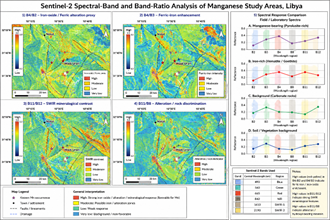
A conceptual prediction framework for assessing the potential for manganese exploration in three important areas—Nalut–Jabal Nafusa, Wadi Urari, and Shati Valley—is presented in this paper. Geological mapping, remote sensing investigation, structural analysis, mineral information, and spatial evaluation of regulating factors impacting manganese mineralization are all included into the methodology. The Nalut–Jabal Nafusa region exhibits potential for fault-controlled mineralization and manganese deposits supported by carbonate. An interesting site connected to structural pathways and sedimentary deposits on the edge of the Ghadames Basin is Wadi Urari. Due to local tectonic features regulating mineral accumulation and iron-bearing Carboniferous strata, the Shati Valley region exhibits considerable promise. The obtained results can serve as an initial guide to the areas of priority exploration, mineral assessments, and geochemical surveys. In addition to the potential mineralization sites, sustainable manganese production can also help Libya achieve economic diversification through processing, creating jobs, and contributing to critical mineral supply chains for hydrogen-based energy systems. However, detailed research, environmental impact assessments, and economic evaluations are required before any significant commercial production can commence.
Downloads
Downloads
Published
Issue
Section
License
Copyright (c) 2026 The authors

This work is licensed under a Creative Commons Attribution-NonCommercial 4.0 International License.
This journal uses Creative Commons Attribution-Noncommerical 4.0 International License (CC BY-NC 4.0), which permits use, sharing, adaptation, distribution and reproduction in any medium or format, as long as you give appropriate credit to the original author(s) and the source, provide a link to the Creative Commons license, and indicate if changes were made. To view a copy of this license, visit https://creativecommons.org/licenses/by-nc/4.0/.
Copyright of articles
Authors retain copyright of their articles published in this journal.