Comparison of R-Adaptive Unscented Kalman Filters for Sensorless PMSM Estimation
DOI:
https://doi.org/10.63318/waujpasv4i2_44Keywords:
Permanent magnet synchronous motor, Sensorless state estimation, Adaptive unscented Kalman filter, Measurement-noise covariance, Statistical consistency, Monte Carlo simulationAbstract
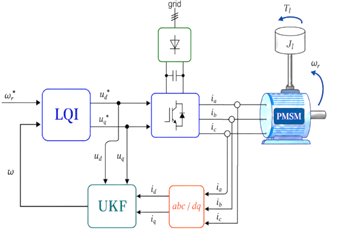
This paper compares three unscented Kalman filters that adapt the measurement covariance R for sensorless permanent magnet synchronous motor (PMSM) estimation: an exponentially weighted UKF (UKF-QR), a master–slave UKF (UKF-MSQ), and a bounded Sage–Husa UKF (UKF-SH). The main contribution is a controlled comparison using the same initial conditions, voltage inputs, and noisy current measurements along a common PMSM trajectory generated by linear quadratic integral (LQI) speed control. Each adaptation coefficient is selected independently using Bayesian optimization and development tests, then fixed before evaluation. Two 50-trial Monte Carlo tests examine measurement-noise changes alone and in combination with parameter mismatch, speed changes, and load disturbances. Fixed-R and oracle-R UKFs provide reference results. In the noise-only test, the adaptive filters reduce settled-window mean squared error (MSE) by about 80% for d-axis current, 86% for q-axis current, and 70–71% for speed relative to the fixed UKF. UKF-QR gives the lowest MSE among the adaptive filters. Under combined stress, UKF-MSQ gives the lowest adaptive d-axis current and speed MSE, 2.809 × 10⁻³ A² and 7.265 × 10⁻³ (rad/s)², and the best average covariance tracking. UKF-QR gives the lowest adaptive q-axis current MSE. UKF-MSQ also has the lowest 95th-percentile speed MSE among the adaptive filters, although the fixed and oracle-R references give lower values. These results favor UKF-MSQ when average speed accuracy and covariance tracking are the main priorities under the tested disturbances.
Downloads
Downloads
Published
Issue
Section
License
Copyright (c) 2026 Salah Abokhatwa, Abubaker Zawam

This work is licensed under a Creative Commons Attribution-NonCommercial 4.0 International License.
This journal uses Creative Commons Attribution-Noncommerical 4.0 International License (CC BY-NC 4.0), which permits use, sharing, adaptation, distribution and reproduction in any medium or format, as long as you give appropriate credit to the original author(s) and the source, provide a link to the Creative Commons license, and indicate if changes were made. To view a copy of this license, visit https://creativecommons.org/licenses/by-nc/4.0/.
Copyright of articles
Authors retain copyright of their articles published in this journal.