A Mathematical Model of the Effects of Beneficial and Pathogenic Gut Bacteria on Insulin Resistance Using Differential Equations
DOI:
https://doi.org/10.63318/waujpasv4i2_53Keywords:
Ordinary differential equations, Insulin resistance, Gut microbiota, Stability analysis, Dysbiosis, Runge–Kutta methodAbstract
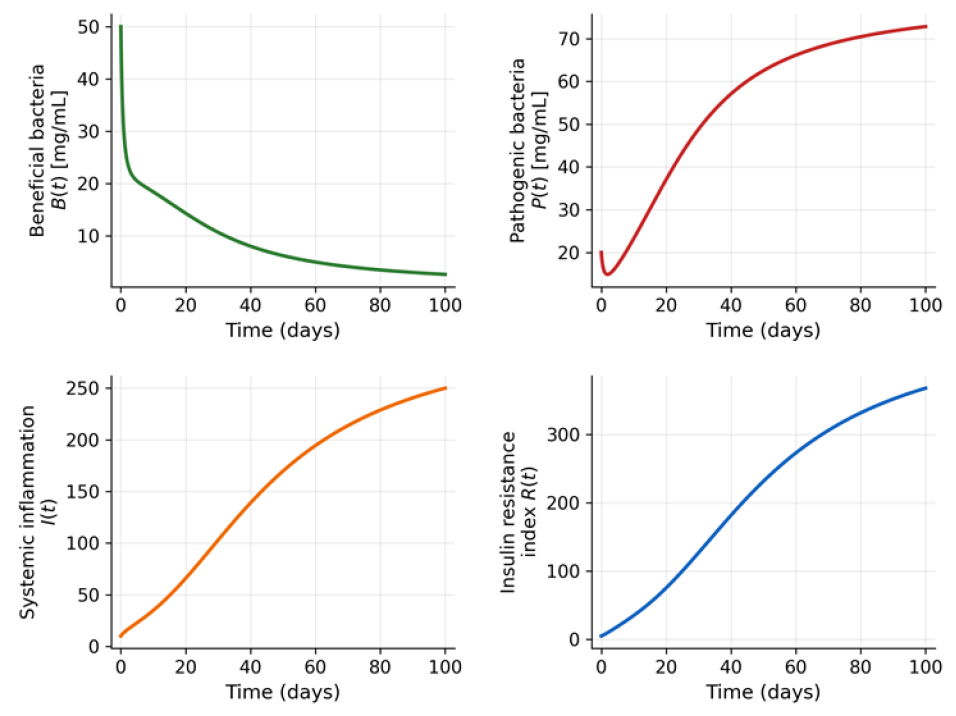
Insulin resistance is increasingly understood to be shaped by alterations in the gut microbiota rather than arising solely from dysfunction of peripheral insulin-sensitive tissues. Over the past decade, microbiome research has established a bidirectional relationship between intestinal bacteria and host metabolism. In this study, we formulate a four-dimensional system of ordinary differential equations that tracks beneficial bacteria, pathogenic bacteria, bacterially induced systemic inflammation, and an insulin resistance index. The model assumes that beneficial and pathogenic bacterial populations grow logistically and compete for shared intestinal resources. Pathogenic bacteria release lipopolysaccharide (LPS), which elevates systemic inflammation, while beneficial bacteria and their short-chain fatty acid (SCFA) metabolites attenuate this inflammatory response; inflammation, in turn, drives insulin resistance, with the system retaining an intrinsic capacity for recovery. We show that solutions originating from a healthy state remain positive and bounded, identify four biologically relevant equilibria, and derive a basic reproduction number governing stability of the disease-free equilibrium. Stability of the coexistence (chronic dysbiosis) equilibrium is established via a Routh–Hurwitz argument, and a normalized sensitivity analysis identifies the parameters exerting the greatest influence on the insulin resistance index. Fourth-order Runge–Kutta simulations under two contrasting parameter regimes confirm the analytical predictions: the system returns to a healthy state when the reproduction number is below unity and evolves toward persistent, clinically dysbiosis-like inflammation when it exceeds unity. Although parsimonious, the model supports the hypothesis that restoring microbial balance, rather than treating inflammation alone, is central to the long-term resolution of insulin resistance.
Downloads
Downloads
Published
Issue
Section
License
Copyright (c) 2026 The authors

This work is licensed under a Creative Commons Attribution-NonCommercial 4.0 International License.
This journal uses Creative Commons Attribution-Noncommerical 4.0 International License (CC BY-NC 4.0), which permits use, sharing, adaptation, distribution and reproduction in any medium or format, as long as you give appropriate credit to the original author(s) and the source, provide a link to the Creative Commons license, and indicate if changes were made. To view a copy of this license, visit https://creativecommons.org/licenses/by-nc/4.0/.
Copyright of articles
Authors retain copyright of their articles published in this journal.