Enhanced Hybrid Underwater Target Tracking: A Virtual Array MIMO SONAR Framework with CA-EKF-TOMHT
DOI:
https://doi.org/10.63318/waujpasv4i2_66Keywords:
MIMO SONAR, Underwater Target Tracking, Extended Kalman Filter (EKF), Track-Oriented Multiple, Hypothesis Tracking (TOMHT), Monte Carlo SimulationAbstract
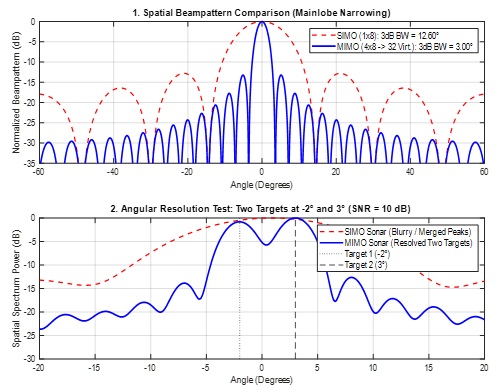
Tracking submerged targets in shallow-water acoustic environments poses severe operational challenges due to low Signal-to-Noise Ratio (SNR), ambient clutter, and range unobservability in passive bearings-only tracking. Conventional Single-Input Multiple-Output (SIMO) SONAR setups combined with Track-Oriented Multiple Hypothesis Tracking (TOMHT) often suffer from heavy computational loads because wide validation gates admit excessive clutter measurements. To address this gap, this paper investigates a hybrid target tracking framework combining a 6D Constant Acceleration Extended Kalman Filter with TOMHT (6D CA-EKF-TOMHT) integrated into a Virtual Array MIMO SONAR architecture ( ). The operational method employs a dual-phase strategy: covert passive bearings-only tracking ( ) followed by active range-bearing interrogation ( ). All reported quantitative performance metrics are evaluated as ensemble statistical averages across 100 independent Monte Carlo simulation runs in MATLAB R2024b. Virtual array synthesis expands the effective receiving aperture to 32 virtual elements, yielding an active signal processing gain of (increasing SNR from to ) and reducing measurement noise standard deviations by . Statistical evaluation confirms that the active position Root Mean Square Error (RMSE) decreases from to ( error reduction), while the average active track hypothesis counts drops from to ( tree reduction). The resulting contracted Mahalanobis validation gates suppress clutter hypothesis proliferation, accelerating processing latency from to ( speedup) under the simulated conditions.
Downloads
Downloads
Published
Issue
Section
License
Copyright (c) 2026 Authors

This work is licensed under a Creative Commons Attribution-NonCommercial 4.0 International License.
This journal uses Creative Commons Attribution-Noncommerical 4.0 International License (CC BY-NC 4.0), which permits use, sharing, adaptation, distribution and reproduction in any medium or format, as long as you give appropriate credit to the original author(s) and the source, provide a link to the Creative Commons license, and indicate if changes were made. To view a copy of this license, visit https://creativecommons.org/licenses/by-nc/4.0/.
Copyright of articles
Authors retain copyright of their articles published in this journal.