The Impact of Type 2 Diabetes Mellitus on Renal Function: Assessment Using the CKD-EPI 2021 Equation in Derna City, Libya
DOI:
https://doi.org/10.63318/waujpasv4i1_53Keywords:
Type 2 diabetes mellitus, Diabetic kidney disease, Renal function, Early detection, LibyaAbstract
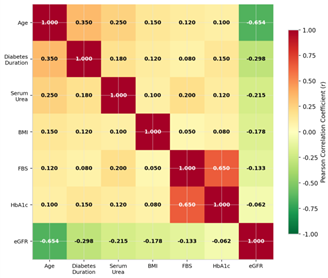
Long‑standing type 2 diabetes mellitus (T2DM) is a major risk factor for diabetic kidney disease and chronic kidney disease (CKD), yet early diagnosis remains difficult because serum creatinine often stays normal until substantial renal tissue is lost. Local data in Derna, Libya, are scarce. This case‑control study evaluated the CKD‑EPI 2021 race‑free equation for early detection of renal impairment in 77 T2DM patients and 20 healthy controls recruited from the Cardiac and Diabetes Center in Derna. Fasting glucose, HbA1c, serum urea, and serum creatinine were measured, and eGFR was calculated using the 2021 equation. Diabetic patients had significantly lower eGFR than controls (98.5 ± 12.8 vs. 112.8 ± 11.4 mL/min/1.73 m²; p < 0.001). 13.0% of patients were in Stage 2–3 CKD despite normal creatinine values. Age was the strongest predictor of eGFR decline (r = −0.654; p < 0.001), while HbA1c showed no cross‑sectional correlation (r = −0.062; p = 0.592). Smoking status did not influence eGFR in either group. These findings demonstrate that the CKD‑EPI 2021 equation unmasks early renal impairment missed by creatinine alone and support routine eGFR reporting, particularly for older patients, in Libyan diabetes care.
Downloads
Downloads
Published
Issue
Section
License
Copyright (c) 2026 The authors

This work is licensed under a Creative Commons Attribution-NonCommercial 4.0 International License.
This journal uses Creative Commons Attribution-Noncommerical 4.0 International License (CC BY-NC 4.0), which permits use, sharing, adaptation, distribution and reproduction in any medium or format, as long as you give appropriate credit to the original author(s) and the source, provide a link to the Creative Commons license, and indicate if changes were made. To view a copy of this license, visit https://creativecommons.org/licenses/by-nc/4.0/.
Copyright of articles
Authors retain copyright of their articles published in this journal.